Welding Programs
Get started with your career as a Welder and enroll at McAllen Careers Institute today!
TAKE THE NEXT STEP
WELDING SPECIALIST PROGRAM
Start your path towards a new career and finish in as little as 7 months

The Welding Techniques
You Can Learn

Stick
This style uses a flux-coated, consumable “stick” electrode to create the arc and lay weld metal, while the flux breaks down to form shielding gas and a protective slag over the weld.
It’s a go-to process for general steel work, maintenance, and repair because the equipment is simple, portable, and works well in less-than-perfect conditions (including outdoor jobs).

Flux Core Arc (FCAW)
FCAW uses an electrode filled with flux that helps protect the weld and support strong penetration. There are two common types: self-shielded (no external shielding gas—handy outdoors) and gas-shielded (uses shielding gas for cleaner results in controlled environments). FCAW is popular for heavier steel and production work because it can deposit weld metal quickly.

TIG
TIG uses a non-consumable tungsten electrode to produce the arc, with an inert shielding gas (often argon) protecting the weld area from contamination. Filler metal may be added by hand when needed, which gives the welder a lot of control over bead shape and heat input. TIG is known for clean, precise welds, especially on thinner materials.

Oxy-Fuel Cutting
Oxy-fuel cutting uses a torch with oxygen and a fuel gas to heat metal, then a stream of oxygen rapidly oxidizes steel to create the cut (often described as controlled “rusting”).
This process is commonly used to cut plate, trim and bevel edges, and prep parts for fit-up, key steps in basic fabrication work.
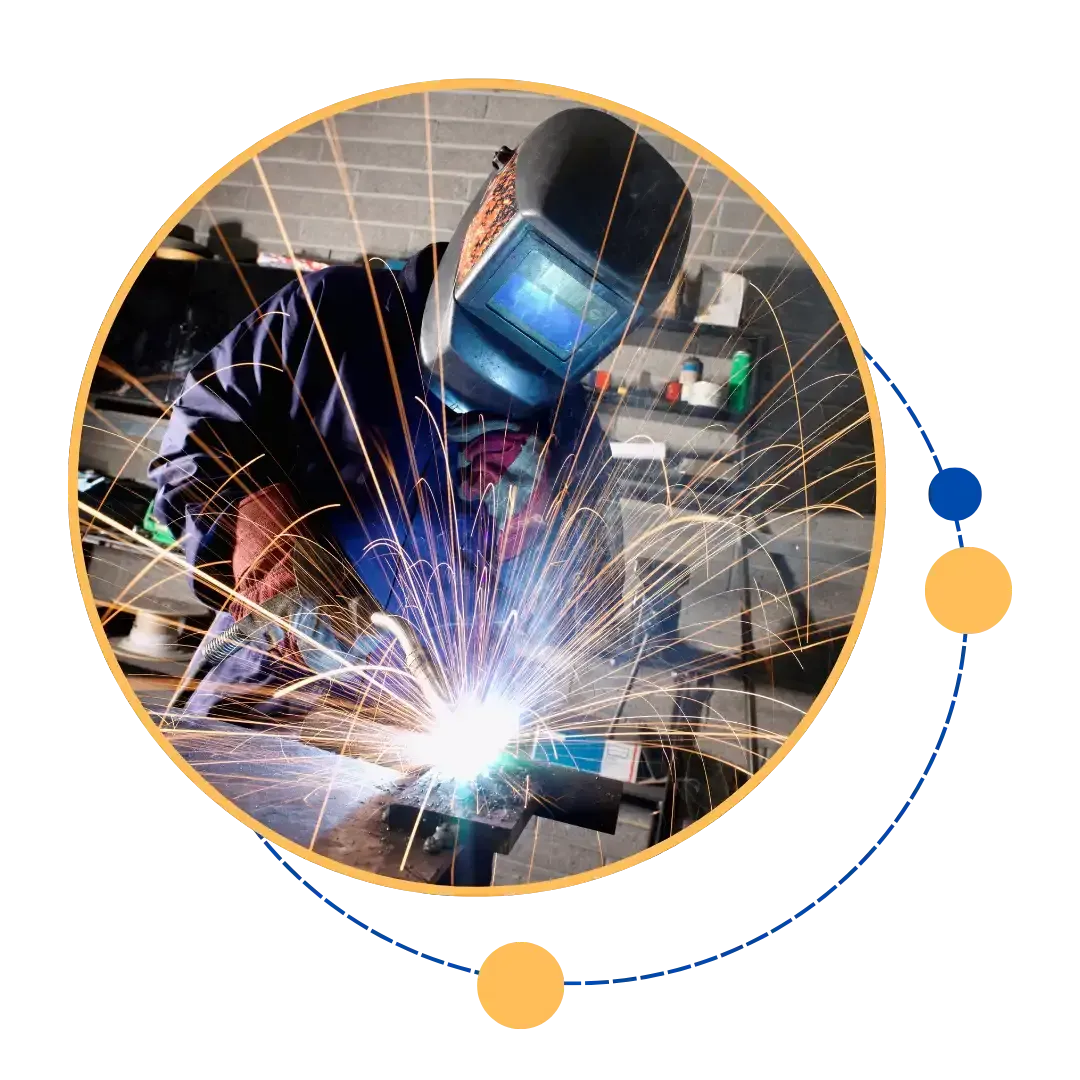
Hands-on from Day One
Everything you do prepares you for your future career. If you can’t apply it, we don’t teach it.
Clear Pathway
The course plan and curriculum is designed to help you hit the field as fast as possible while giving you guidance at each step for the skills you need to build a career.
More Reps, More Confidence
Build more skills in a specialist program than a simple 8 week less crash course
HEAR FROM OUR STUDENTS
Who IS The Welding Specialist Program For?
Individuals new to or inexperienced with welding and want a thorough, shop- heavy start
Those who are looking to build the skills needed to get a leg up in the career marketplace
Habitual tinkerers ready to formalize their skills with instructor feedback
What WILL You Study?
We start from scratch, including on how to read blueprints. The program gives you the opportunity to practice core welding techniques used on real jobsites such as :
Stick (or Shielded Metal Arc)
Flux Core Arc
TIG or Gas Tungsten
Oxy-fuel cutting & basic fabrication
We also want you to hit the field as fast as possible. The program is scheduled to take less than a year and can be completed in as little as 7 months!
Testimonials
Christopher Whitlock
- Welding Student
“Great Instructor. Great staff!”
Eduardo Lopez
- Welding Student
“Amazing Instructors. Great hands on experience! Would highly recommend.”
Nikolai Albrecht
- Welding Student
“Knowledgeable instructors, Professional staff.”
FAQs
Find Answers to Your Questions
How long is the program?
Students can finish in as little as 7 months, but the program requires 900 course hours. Once the student has demonstrated competence and completed 900 (including 736 lab and 164 lecture hours), the program is complete.
Do I need experience or prior education?
No prior welding experience is required! We start with the basics, including shop safety.
I don’t understand how to read blueprints. Can I still be a welder?
While reading blueprints is important, we help you learn from scratch. If there’s something you don’t understand, we’ll just try again until you have it down.
Are welding jobs in demand?
Welders help in several industries. Here is a small snapshot of the kinds of work welders do everyday.
Construction & Structural steel
• Beams/columns
• Trusses
• Stairs
• Handrails
• And bridge components
Industrial plants
• Platforms
• Hoppers
• Chutes
• Conveyors
• And tanks
Automotive & Motorsports
• Roll cages
• Chassis work
• Exhaust
And radiator piping